
Jay Enderson’s Three Oak Winery in Albert Lea, Minnesota, was anything but a shoe-in when his La Crescent won silver and his Frontenac Gris won best in show and the Governor’s Cup for the best Minnesota wine last year at the International Cold Climate Wine Competition (ICCWC). In fact, they weren’t even open yet.
Far from sitting by the phone with baited breath, Enderson was working in the fields when he got the call. “I was shocked,” he says, who was only in his second year of production. “We just wanted to get our feet wet to see where we fell.”
He says he had some idea his Frontenac Gris was good. He had consulted a tasting panel of around 15 people on the wine’s sweetness level before taking it to bottle, assuming he was going to have to add in some California grapes to alter its natural flavor, but the results came back unanimously that the tasters liked the wine as it was. “We needed to get the word out, and get some sales going,” Enderson says, so he drove some bottles of wine up to the Twin Cities to see what PR he could drum up, including some for entry into the ICCWC. Little did he know how fortuitous that excursion would become.
Suddenly on the map
Following the 2015 ICCWC win, Three Oak Wines also won double gold, gold and silver at the Finger Lakes International Wine Competition, which includes wines from all climates from all over the world. Enderson says this, combined with the ICCWC win, has given Three Oak a lot of visibility, which he’s still taking in.
“10 years ago I barely drank wine; maybe a couple glasses at the holidays. I had no preconceived notions about wine, no hard-edged opinions.” Enderson learned viticulture through an online course from VESTA six years ago, bottling his first vintage four years ago. He says, “Having a small operation allowed us to get a good handle on making the best wine we can. Forced us to, really — we had no choice but to put all our effort into the quality of the wine before we got a lot of production volume going.”
After the ICCWC win, however, Enderson found himself wishing he had overproduced. While he was happy to find himself suddenly on the map, he was fielding calls every day and having to turn down orders he couldn’t commit to — Three Oak had only bottled 600 bottles of the Governor’s Cup-winning Frontenac Gris.
A work in progress
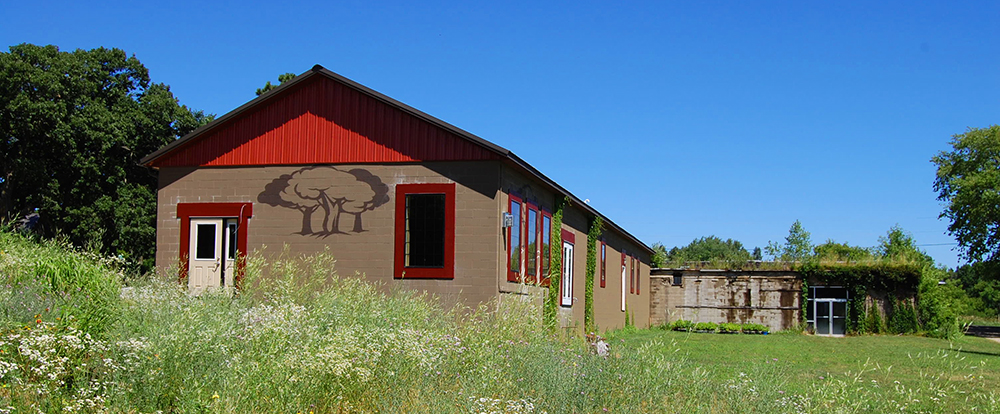
When they won in August of 2015, Three Oak Winery wasn’t even open yet, and still mostly isn’t — while they’ve hosted some events in their outdoor space, the public part of the buildings haven’t opened for business. The tasting room is mostly finished but still a work in progress; Enderson hopes to have limited hours by October to prepare for a grand opening in spring of 2017.
It’s a busy time of year for wineries, and especially for Three Oak — this year’s ICCWC is right around the corner, and Three Oak just hosted the Minnesota Grape Growers Association’s annual picnic — an honor bestowed on the incumbent winner of the Governor’s Cup whether they want it or not. They also hope to represent themselves at the Summer Wine Fest shortly after it. Northern climate harvests are coming up in the Fall, and when I visited, the five acres of vineyard were being hedged for excess foliage.
The premises of Three Oak had been a landscape nursery called the Wedge Nursery since the 1920s; when Enderson talks to Albert Lea locals, they still usually refer to it as the Wedge. (He considered using the name for its recognition in the area, but decided against it as it refers to a family that used to own the nursery.) Still, he’s trying to adapt the grounds rather than overhaul them completely, to maintain some of the history of the area. There’s an underground root room with a dirt floor that might come in handy some day, and he’s repurposed the nursery’s old corrugated metal roof as the front of the bar in the tasting room, replacing it with a beautiful wooden ceiling belying Enderson’s other career — the log home business.
Enderson describes Three Oak Winery as a labor of love. Unlike some wineries, he’s never had any outside investors, so each step of building the business has been a gradual addition. (He hopes to get a barrel program going next — they use Oak additives currently.)
Advice from an award-winner
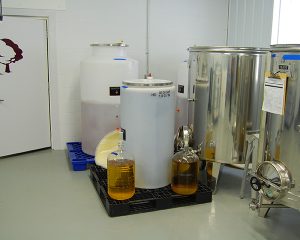
Winemaking isn’t that complicated, according to Enderson. Simplicity and cleanliness in your facilities and processes are the most important factors. Small batches allow for a lot of attention to be paid to quality control. He thinks some winemakers have a tendency to overthink their wines; Enderson tries to let the natural flavor the grapes produce come through, and minimizes blending. While a lot of Minnesota wineries habitually blend their Marquette with non-cold climate grapes, Three Oak’s is straight Minnesota grapes — and Enderson thinks it’s better that way. “The flavor of the Marquette changes from year to year based on the grapes, but our La Crescent and Frontenac Gris have had a lot of consistency.”
Looking ahead
This year, Three Oak will submit their previous winners, Frontenac Gris and La Crescent, as well as Marquette and possibly the Elmer Swenson variety Brianna to the ICCWC. Enderson is confident this year’s Frontenac Gris is up to snuff of the quality of last year’s winning vintage, and he’s made sure to have more of it available.
Three Oak currently produces 11 wines, but Enderson’s eye is on paring down his selections, not diversifying. Three Oak wines are available in Hy-Vees in Southern Minnesota and by contacting Three Oak directly. Enderson would like to widen his distribution, but he isn’t too worried: “Once people realize you have a quality wine, that outdoes any fancy building. If you have great wine, you could sell it from a fruit stand by the side of the road.”
